Экономическая
610Pessen E. The Egalitarian Myth and American Social Reality: Wealth, Mobility and Equality in the Era of the Common Man // American Historical Review, 76 1971. Р. 1017, 1019–1026.
611 Общая картина выглядела так:
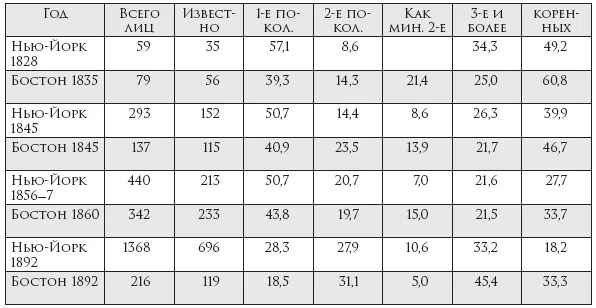
(Jaher F.C. Nineteenth Century Elites in Boston and New York // Journal of Social History, 5 (Fall.1972). P 37–39, 42, 55.)
612Gregory F., Neu I. The American Industrial Elite in the 1870’s: Their Social Origins // Men in Business: Essays in the History of Enterpreneurship. Ed. by W. Miller. Cambridge, 1952. Р. 202–203.
613Miller W. The Recruitment of the Business Elite // Quarterly Journal of Economics. Vol. LXIV, N 2 May 1950. Р. 201, 252.
614 Исследование биографий 1464 бизнесменов, родившихся до 1879 г., помещенных в «Американском биографическом словаре» словаре, дало следующие данные:
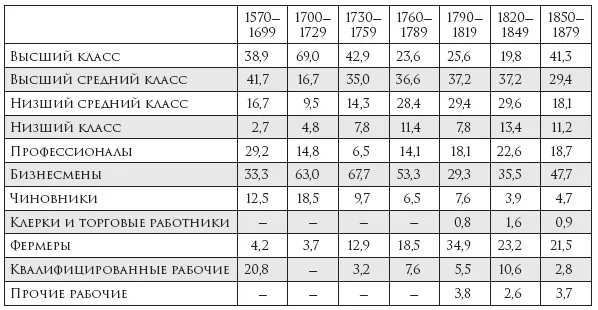
(Mills W The American Business Elite: A Collective Portrait. P. 30, 32.)
615Mannari H. The Japanese Business Leaders. Р. 192.
616Миллс Р. Властвующая элита. С. 140–141, 144, 173–176, 502.
617Bendix R., Howton F.W. Social Mobility and the American Business Elite // The British Journal of Sociology, IX, 1 (March, 1958). Р. 122; Kaelble H. Social Mobility in the 19th and 20th Centuries: Europe and America in Comparative Perspective. St.Martin’s Press, 1985. Р. 100, 115.
618Keller S. Beyond the Ruling Class: Strategic Elites in Modern Society. Р. 294.
619Newcomer M. The Chief Executives of Large Business Corporations. Р. 21, 26, 11.
620Mills W. The American Business Elite: A Collective Portrait // The Tasks of Economic History. Supplement to the Journal of Economic History. V Desember 1945. Р. 30, 32–33, 37.
621Kaelble H. Social Mobility in the 19th and 20th Centuries: Europe and America in Comparative Perspective. Р. 109.
622Bendix R. Higher Civil Servants in American Society // University of Colorado Studies, Series in Sociology, 1 July, 1949. Р. 26.
623 The Nine Hundred // Fortune, November 1952. Р. 235.
624Keller S. Beyond the Ruling Class: Strategic Elites in Modern Society. Р. 294; Mannari H. The Japanese Business Leaders. Р. 57.
625Marger M. Elites and Masses: an Introduction to Political Sociology. Р. 169–171.
626Prewitt K., Stone A. The Ruling Elites. NY., Harper and Row, 1973. Р. 137.
627Barton A.H. Background, Attitudes, and Activities of American Elites // Studies of the structure of national elite groups. Ed. by G. Moore. Greenwich and London, 1985. Р. 179.
628Marger M. Elites and Masses: an Introduction to Political Sociology. Р. 169–171.
629Kaelble H. Social Mobility in the 19th and 20th Centuries: Europe and America in Comparative Perspective. Р. 109.
630Mannari H. The Japanese Business Leaders. Р. 61, 192.
631Perkin H.J. The Third Revolution: professional elites in the modern world. Р. 13.
632Kaelble H. Social Mobility in the 19th and 20th Centuries: Europe and America in Comparative Perspective. Р. 103; Perkin H.J. The Third Revolution: professional elites in the modern world. Р. 13, 17.
633Бирнбаум П., Барук Ш. Беллэш М, Марие А. Французский правящий класс. С. 124–130.
634Perkin H.J. The Third Revolution: professional elites in the modern world. Р. 113.
635Kaelble H. Social Mobility in the 19th and 20th Centuries: Europe and America in Comparative Perspective. Р. 101.
636Hoffman-Lange U., Neumann H., Steinkemper B. Conflict and Consensus among Elites in the Federal Republic of Germany. Р. 248–249.
637Hoffman-Lange U. Structural Prerequisites of Elite Integration in the Federal Republic of Germany. Р. 53.
638Kaelble H. Social Mobility in the 19th and 20th Centuries: Europe and America in Comparative Perspective. Р. 105, 115.
639Галкин А.А. Правящая элита современного капитализма. С. 81–82; Бурлацкий Ф.М., Галкин А.А. Социология. Политика. Международные отношения. С. 146.
640Yanagisako S. Patriarchal Desire: Law and Sentiments of Succession in Italian Capitalist Families // Elites: choice, leadership and succession. Ed. by Pina-Cabral de J., Pedroso de Lima A. Oxford – NY, 2000. P. 70.
641Pedroso de Lima A. «How Did I Became a Leader in My Family Firm?» Assets for Succession in Contemporary Lisbon Financial Elites // Elites: choice, leadership and succession. P. 44–45.
642Mannari H. The Japanese Business Leaders. Р. 18, 25–26, 29, 31, 43, 48, 104, 137, 143, 152, 213, 217.
643Granick D. Managerial Comparisons of Four Developed Countries: France, Britain, United States, and Russia. Р. 192.
Политическая
644Миллс Р. Властвующая элита. С. 527–531.
645Miller W. The Recruitment of the Business Elite // Quarterly Journal of Economics. Vol. LXIV, N 2 May 1950. Р. 252.
646Marger M. Elites and Masses: an Introduction to Political Sociology. Р. 168.
647Matthews D.R. The Social Background of Political Decision-Makers. Р. 23.
648Zweigenhaft R. Who Represents America? // Insurgent Sociologist 1975 (Spring). Р. 123, 126–127.
649Aberbach J.D., Rockman B.A. The Overlapping Worlds of American Federal Executives and Congressmen. Р. 27.
650Barton A.H. Background, Attitudes, and Activities of American Elites // Studies of the structure of national elite groups. Ed. by G. Moore. Greenwich and London, 1985. Р. 179.
651 Состав по происхождению членов консервативных (К), либеральных (Л) и лейбористских (Р) кабинетов выглядел следующим образом (%):
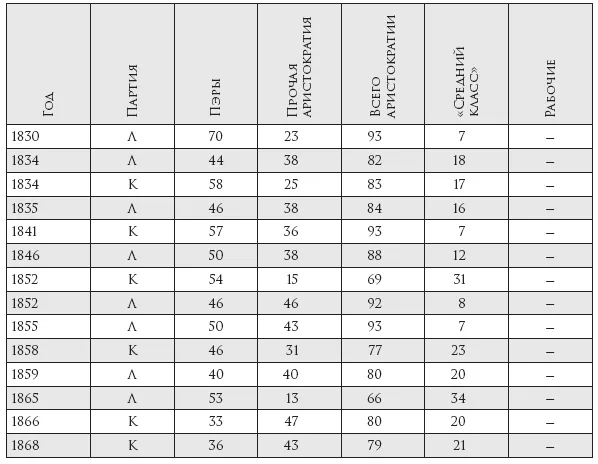
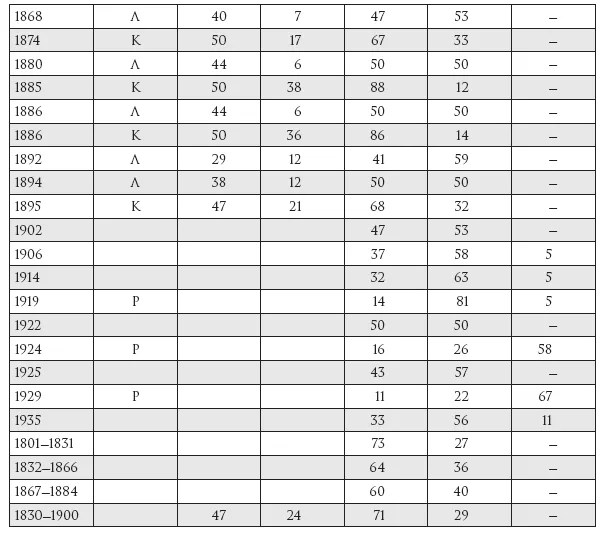
(Matthews D.R. The Social Background of Political Decision-Makers. Р. 43; Arnstein W.L. The Survival of the Victorian Aristocracy // The Rich, the Well Born, and the Powerful; Elites and Upper Classes in History. Ed. by F.C. Jaher. Urbana— Chicago-London, 1973. Р. 210.)
652Laski H.J. The Personnel of the British Cabinet, 1801–1924 // American Political Science Review, Vol. 22 (1), 1928. Р. 21, 28.
653Matthews D.R. The Social Background of Political Decision-Makers. Р. 44, 46; Guttsman W.L. The Changing Social Structure of the British Political Elite // British Journal of Sociology, Vol. 2 (2), 1951. Р. 126; Guttsman W.L. Elite Recruitment and Political Leadership in Britain and Germany since 1950. P. 112; Guttsman W.L. The British Political Elite. Р. 79.
654Hanby V.J. A Changing Labour Elite: The National Executive Committee of the Labour Party 1900—72 // Elites in Western democracy. P. 129, 147.
655Johnson R.W. The British Political Elite 1955–1970 // European Journal of Sociology, Vol. 14, No. 1, June 1973. Р. 49–50, 52.
656Matthews D.R. The Social Background of Political Decision-Makers. Р. 49.
657Guttsman W.L. Elite Recruitment and Political Leadership in Britain and Germany since 1950. Р. 112.
658Eldersveld S.J. Changes in Elite Composition and the Survival of Party Sistems: The German Case // Does who governs matter? Elite circulation in contemporary societies. P. 86.
659 Государственная служба основных капиталистических стран. С. 243–244.
660Hoffman-Lange U. Structural Prerequisites of Elite Integration in the Federal Republic of Germany. Р. 53, 58.
661Hoffman-Lange U., Neumann H., Steinkemper B. Conflict and Consensus among Elites in the Federal Republic of Germany. Р. 248–249.
662Hoffman-Lange U. Structural Prerequisites of Elite Integration in the Federal Republic of Germany. Р. 53, 58.
663Hamon L. The Members of the French Parliament // International Social Science Journal, XIII, 4 (1961). Р. 549–550.
664Cayrol R., Perrineau P. Governing Elites in a Changing Industrial Society” The Case of France // Does who governs matter? Elite circulation in contemporary societies. Р. 102.
665 Ibid. P. 92.
666 Ibid. P. 101.
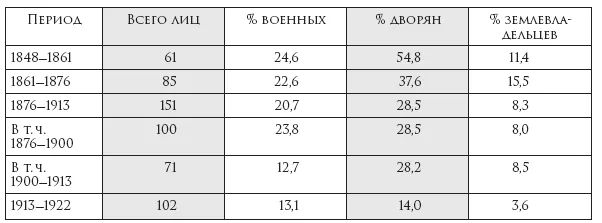
667 Доля некоторых социальных групп в составе министров Италии конца XIX – начала XX вв. выглядела следующим образом:
(Who Governs Southern Europe?: Regime Change and Ministerial Recruitment, 1850–2000. Р. 126.)
668Levis P.H. Latin Fascist Elites: The Mussolini, Franco, and Salazar Regimes. Westport, 2002. Р. 181.
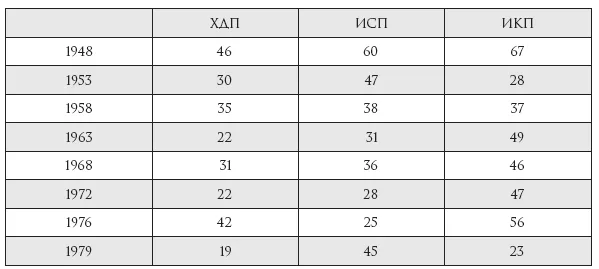
669 Доля итальянских депутатов, избранных впервые по партиям выглядела так:
(Gotta M. The Italian Political Class in the Twentieth Century: Continuities and Discontinuities // Does who governs matter? Elite circulation in contemporary societies. Р 160–164, 178.)
670Gotta M. The Italian Political Class in the Twentieth Century: Continuities and Discontinuities. Р. 160–164, 178).
671Linz J.J., Gangas P., Jerez M. Spanish Diputados: From the Restoration to Consolidated Democracy // Parliamentary Representatives in Europe 1848–2000. Legislative recruitments and Careers in Eleven European Countries. P. 380, 396.
672 Parliamentary Representatives in Europe 1848–2000. P. 349.
673Волков М.С. Правящая элита Испании второй половины XX в. С. 105.
674Levis P.H. Latin Fascist Elites: The Mussolini, Franco, and Salazar Regimes. Р. 181.
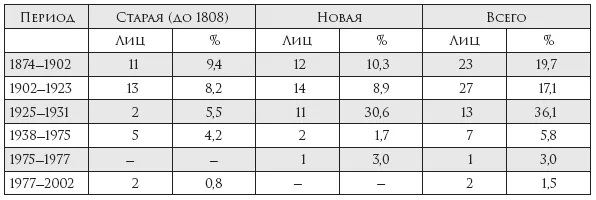
675 Соотношение между старой и новой аристократией было следующим:
(Who Governs Southern Europe?: Regime Change and Ministerial Recruitment, 1850–2000. Р. 101.)
676 Parliamentary Representatives in Europe 1848–2000. P. 355.
677 Who Governs Southern Europe?: Regime Change and Ministerial Recruitment, 1850–2000. Р. 163, 186, 194.
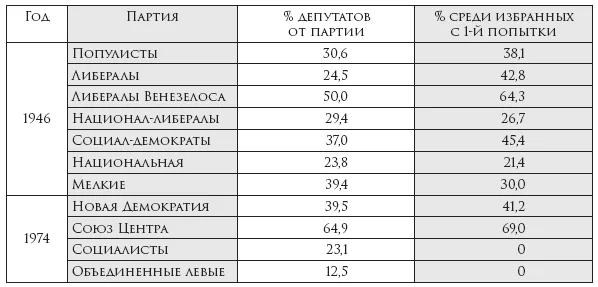
678 Доля депутатов из политических семей по партиям выглядела так:
(Legg K. Restoration Elites: Regime Change in Greece // Does who governs matter? Elite circulation in contemporary societies. P. 204, 207.)
679Daalder H., Berg van der J.T.J. Members of the Dutch Lower House: Pluralism and Democratization, 1848–1967 // Does who governs matter? Elite circulation in contemporary societies. P. 220–222.
680 Parliamentary Representatives in Europe 1848–2000. P. 55.
681Aberbach J.D., Robert D. Putnam R.D., Rockman B.A. Bureaucrats and Politicians in Western Democracies. Р. 53, 55, 63, 73–75.
682 Ibid. P. 60; Perkin H.J. The Third Revolution: professional elites in the modern world. Р. 12.
683 Parliamentary Representatives in Europe 1848–2000. Legislative recruitments and Careers in Eleven European Countries. Р. 35, 71, 106, 160, 219, 243, 291, 329, 480.
684 Ibid. P. 43, 63–69, 99—105, 153, 155–159, 205, 214, 216, 221, 234–241, 284–289, 321–327, 346, 352, 359, 378, 409, 414, 416, 442, 474–479.
685Drake P.W. The Political Responses of the Chilean Upper Class to the Great Depression and the Threat of Socialism, 1931–1933 // The Rich, the Well Born, and the Powerful; Elites and Upper Classes in History. Ed. by F.C. Jaher. Urbana-Chicago-London. 1973. P. 314.
686Bill J.A. The Patterns of Elite Politics in Iran. Р. 36.
687Frey F.W. Patterns of Elite Politics in Turkey. Р. 57.
688Marr Ph. A. The Political Elite in Iraq. Р. 114, 116, 128, 133–134.
689Torrey G.H. Aspects of the Political Elite in Syria // Political Elites in the Middle East. Р. 154–155.
690 Состав парламента по занятиям (%) был следующим:
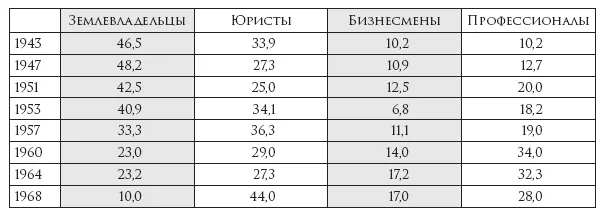
(Harik I.F. Political Elite of Lebanon // Political Elites in the Middle East. Р 201–203, 208–211.)
691Mannari H. The Japanese Business Leaders. Tokyo. Р. 137, 143.
692Волков С.В. Советский истеблишмент. С. 301–303.
Административная и военная
693Миллс Р. Властвующая элита. С. 283–284.
694Keller S. Beyond the Ruling Class: Strategic Elites in Modern Society. P. 297, 307–308.
695Bendix R. Higher Civil Servants in American Society // University of Colorado Studies, Series in Sociology, 1 July, 1949. Р. 26, 29.
696Marger M. Elites and Masses: an Introduction to Political Sociology. P. 168.
697Aberbach J.D., Rockman B.A. The Overlapping Worlds of American Federal Executives and Congressmen. Р. 27.
698Barton A.H. Background, Attitudes, and Activities of American Elites // Studies of the structure of national elite groups. Ed. by G. Moore. Greenwich and London, 1985. Р. 179.
699Marger M. Elites and Masses: an Introduction to Political Sociology. P. 168.
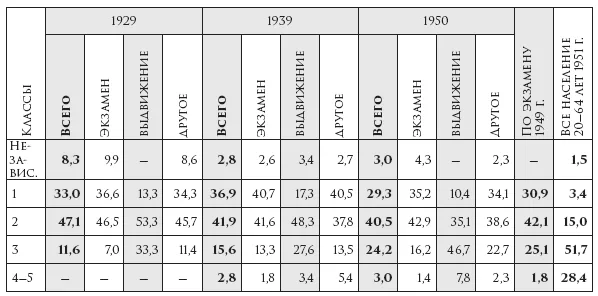
700Kelsall R.K. Higher Civil Servants in Britain from 1870 to the Present Day. Р. 15, 150–151, 153, 157. По типам назначения и принятым в английской статистике социальным классам (1 – профессионалы, кроме учителей, офицеры и чиновники административного класса и равные, 2 – учителя, собственники и менеджеры всех видов бизнеса и прочие чиновники, 3 – прочие клерки, мастера и квалифицированные рабочие, 4 – полуквалифицированные рабочие, 5 – неквалифицированные рабочие) происхождение высших чиновников выглядело так:
701Bendix R. Higher Civil Servants in American Society. P. 29.
702Runge W. Politik und Beamtentum in Parteienstaat. Stuttgart, 1965. S. 186, 244.
703 Государственная служба основных капиталистических стран. С. 237.
704Hoffman-Lange U., Neumann H., Steinkemper B. Conflict and Consensus among Elites in the Federal Republic of Germany. Р. 248–249.
705Hoffman-Lange U. Structural Prerequisites of Elite Integration in the Federal Republic of Germany. Р. 53, 58.
706Бирнбаум П., Барук Ш. Беллэш М, Марие А. Французский правящий класс. С. 124–130.
707Bottomore T. La Mobilite Sociale dans la Haute Administration Francaise // Cahiers Internationaux de Sociologie, XIII (1952). Р. 169, 174.
708Dellbasch Ch. Science administrative. Paris, 1971. P. 421; Государственная служба основных капиталистических стран. С. 190; Крылова И.С. Аппарат государственного управления современной Франции. С. 124.
709Darbel A., Schnapper D. Morphologie de la haute administration francaise. Paris, 1969. P. 18.
710Anton T.J., Linde C., Mellbourn A. Bureaucrats in Politics: A Profile of the Swedish Administrative Elite // Canadian Public Administration, 16 (Winter 1973). Р. 630, 632–634.
711Sobral J.V. Family, Power and Property: Ascendancy and Decline of a Rural Elite // Elites: choice, leadership and succession. P. 162.
712Aberbach J.D., Robert D. Putnam R.D., Rockman B.A. Bureaucrats and Politicians in Western Democracies. Р. 55, 63, 74.
713Schmidhauser J.R. The Circulation of Judicial Elites: A Comparative and Longitudinal Perspective // Does who governs matter? Elite circulation in contemporary societies. P. 44.
714 Political Leadership in Korea. Seattle-London., 1976. P. 95–96.
715Родригес-Фернандес А.М. Формирование современной бюрократической элиты Саудовской Аравии // Вестник МГУ (Востоковедение). 1979. № 3. С. 30.
716Азарх А.Э. Государственные служащие Индии. С. 96–97, 106.
717Федоров В.А. Армия и политический режим в Таиланде. С. 32.
718Миллс Р. Властвующая элита. С. 245–248, 519–521.
719Janowitz M. The Professional Soldier. NY., 1960. Р. 90–92, 99.
720RazzellP.E. Social Origins of Officers in the Indian and British Home Army, 1758–1962 // British Journal of Sociology, Vol. 14 (3), 1963. Р. 253.
721Otley C.B. The Social Origins of British Army Officers. Р. 218, 220.
722Sampson A. The New Anatomy of Britain. Р. 309, 311, 316.
723Hoffman-Lange U., Neumann H., Steinkemper B. Conflict and Consensus among Elites in the Federal Republic of Germany. Р. 248–249.
724Hoffman-Lange U. Structural Prerequisites of Elite Integration in the Federal Republic of Germany. Р. 53, 58.
725Бирнбаум П., Барук Ш. Беллэш М, Марие А. Французский правящий класс. С. 124–130.
726Волков М.С. Правящая элита Испании второй половины XX в. С. 34.
727Словесная Н.Г. Интеллигенция Таиланда / С. 111–112.
728Волков С.В. Советский истеблишмент. С. 330.
Интеллектуальная и культурная
729Jensen R. Metropolitan Elites in the Midwest, 1907–1929: A Study in Multivariate Collective Biography // The Rich, the Well Born, and the Powerful; Elites and Upper Classes in History. Ed. by F.C. Jaher. Urbana – Chicago – London, 1973. P. 291–292.
730Miller W. American Lawyers in Business and Politics // Yale Law Journal. Vol. LX. N 1. January 1951. Р. 68–69.
731Krueger T.A., Glidden W. The New Deal Intellectual Elite: A Collective Portrait // The Rich, the Well Born, and the Powerful; Elites and Upper Classes in History. Ed. by F.C. Jaher. Urbana-Chicago-London, 1973. P. 348–354.
732Paetzold G. Untersuchungen zu wissenschaftlichen Nobelpreisen // Wis-senschaftswiss. Beitr./Sekt. Wissenschaftstheorie und – organization der Humboldt-Univ. zu Berlin, 1982. H. 17. S. 48–49.
733Knapp R.N., Goodrich H.B. The Origins of American Scientists // Studies in Motivations. Ed. by D.C. McClelland. NY., 1955. Р. 349–350.
734Lazarsfeld P.F., Wagner T.J. The Academic Mind. NY., The Free Press of Glencoe, 1958. P. 7, 10.
735Миллс Р. Властвующая элита. С. 113.
736Barton A.H. Background, Attitudes, and Activities of American Elites // Studies of the structure of national elite groups. Ed. by G. Moore. Greenwich and London, 1985. Р. 179.
737Миллс Р. Властвующая элита. С. 113.
738Keller S. Beyond the Ruling Class: Strategic Elites in Modern Society. P. 301–303.
739Willhelm S., Sjoberg G. The Social Characteristics of Entertainers // Social Forces, XXXVII, No. 1 (October, 1958). Р.71.
740Keller S. Beyond the Ruling Class: Strategic Elites in Modern Society. P. 301–303.
741Morgan D.H.J. The Social and Educational Background of Anglican Bishops: Continuities and Changes // British Journal of Sociology, vol. 20 (3), September 1969. Р. 297.
742Hoffman-Lange U., Neumann H., Steinkemper B. Conflict and Consensus among Elites in the Federal Republic of Germany. Р. 248–249.
743Hoffman-Lange U. Structural Prerequisites of Elite Integration in the Federal Republic of Germany. Р. 53, 58.
744Бирнбаум П., Барук Ш. Беллэш М, Марие А. Французский правящий класс. С. 124–130.
745Mannari H. The Japanese Business Leaders. Р. 137, 143.
746Bill J.A. The Patterns of Elite Politics in Iran. Р. 37
747Волков С.В. Советский истеблишмент. С. 352.
748Keller S. Beyond the Ruling Class: Strategic Elites in Modern Society. P. 310–312.
749Hoffman-Lange U. Structural Prerequisites of Elite Integration in the Federal Republic of Germany. P. 53.
750Бирнбаум П., Барук Ш. Беллэш М, Марие А. Французский правящий класс. С. 124–130.
751Higley J., Deacon D. The Australian National Elite in the 1970s and 1980s // Studies of the structure of national elite groups. Ed. by G. Moore. Greenwich and London, 1985. P. 104–105.
752Mannari H. The Japanese Business Leaders. Р. 137, 143.